Tsom Nebiyat / Fast of the Prophets
Christmas fast 11/25/2019 - 01/6/2020
Tsome Gena Hedar 15 - Tahisas 28
|
|
Sebket / Advent - The feast to commemorate the preaching of the Prophets that the Messiah will come to
redeem His people from bondage.
The aim of the Church is to cause her children to reflect. During the year she sets apart two seasons in
which she imbues the faithful with a spirit of penitential fervor. One of these seasons, which is called
Advent, from the Latin word Adventus,(arrival), embraces about five Sundays.
The law and practice of the Church is observed strictly, though not so much as in Lent. It is a time for
devout and penitential preparation of the soul for the proper and worthy celebration of the great feast of
the Birth of Christ.
In Advent (Sebket, in Amharic) a fast is kept, the Christmas Fast of 40 days beginning on 15 Hedar and
ending on Christmas eve with the Fast of Gena on the 28 of Tahsas/ January 7
CHRISTMAS
Year after year the Christmas season brings to the minds of all Christians the story of the Child in the
manger, the shepherds on the Judean hills, the Celestial songs “Glory to God in the highest”, and the Angle’s
message, telling that the Long expected one had come.
Liddet or Gena is the Ethiopian name for Christmas which is marked by special ceremonies. The origin is
basically the same as is universally accepted. It is celebrated on 7th January (Tahsas 29 E.C) preceded by a
fast of 40 days. The difference of date is due to a calendar of discrepancy since the Ethiopian calendar is
based on the year of Grace 7 or 8 years after Anno Domini. The Ethiopian Christmas coincides with the date
of this observance in the Eastern Orthodox dispensation.
Qiddus Bale Wold is another name for Christmas in addition to Lidet or Gena. Gena is also a name for a
Christmas game played by boys and grown up men (like hockey).
Source: Tsega Tekle Haimanot ~ FB post ~ 25 Nov 2019
|
Melkam Gena / Melkam Genna
(Ethiopian Christmas)
"Happy / Merry Christmas"
01/07/YYYY
|
|
| |
Melkam Gena!!!
"Gena" (Ethiopian Christmas/Annual Feast Commemorating the Birth of Our Lord, God, and Savior Jesus Christ) (7 January)
While the Gregorian calendar celebrates Christmas on the 25th of December, Ethiopia still retains the ancient Julian calendar in
which Christmas falls on January 7th (of the Gregorian calendar.) It's typically a hot summer day and people in towns and villages
dress up in their finest to celebrate.
The Ethiopian name given to Christmas is, 'Lidet' or 'Gena' which, according to elders, comes from the word Gennana, meaning
"imminent" to express the coming of the Lord and the freeing of mankind from sin. Gena is also the name given to a hockey-like
ball game. Legend has it that when shepherds heard of the birth of Christ they rejoiced and started playing the game with their
sticks. Men and boys in villages will play the traditional Gena game with great enthusiasm in the late afternoon of Christmas day, a
spectacle much enjoyed by village communities and the elders who referee the game.
Gena festivities begin early in the day, as early as 6:00am when people gather in churches for mass, for the clergy it has begun
much earlier. 43 days prior to Gena is the pensive fasting period required of the clergy and is known as the fast of the prophets.
The fast of Advent is carried out to cleanse the body and soul in preparation for the day of the birth of Christ. Everyone stands
throughout the worship service for up to three hours. The clergy and Debtera (scholars versed in the liturgy and music of the
church) lift their voices in hymn and chant just as it has been for over a 1,500 years when Ethiopia accepted Christianity. This
ancient rite culminates in the spectacular procession of the Tabot (the Tabot is symbolic of the Ark of the Covenant) and carried
on top of a priest's head). The procession makes its way three times around the church amidst ululation and chiming church bells,
dazzling umbrellas and colorful attire of the clergy and Debteras (especially designated to accompany the Tabot) as well as a
throng of Christians who follow the procession with lighted candles.
Afterwards, people disperse to their homes to feast and the clergy break their fast. Food and drink are plentiful, with many homes
preparing the special meals characteristic of all big festivities highlighted on the Ethiopian calendar. Food served at Christmas
includes Doro Wat and Injera, a spicy chicken stew eaten with the sourdough pancake-like bread. Often, tej, a local wine-like drink
made from honey, accompanies the feast.
Christmas is quietly shared and celebrated in groups of friends and family. Gift giving is a very small part of Christmas festivities in
Ethiopia. Only small gifts are exchanged amongst family and friends at home. But one gift most eagerly awaited by all children is a
new outfit that they wear with pride on Christmas Day. The festive mood continues until the late hours of the evening. The joy of
giving and sharing, extends beyond religious beliefs and spreads the spirit of peace on earth and goodwill to all mankind
throughout the world.
Source: Tsega Tekle Haimanot ~ FB post ~ 6 Jan 2020
|
On January 7, according to the Julian Calendar, Ethiopia has been celebrating the Birth of Christ since 330 A.D
"For unto us a Child is born,
Unto us a Son is given;
And the government will be upon His shoulder.
And His name will be called
Wonderful, Counselor, Mighty God,
Everlasting Father, Prince of Peace"
(Isaiah 9:6)
Amete Alem (Era of the world) & Amete Mehret (Era of Mercy)
The Christian Era is referred to as Amete Mehret (Era of Mercy). The time from the Creation of the world up to the birth of Christ is
referred to as Amete Alem (Era of the world) and is reckoned to be 5,500 years, the figure mentioned in the septuagist.
The Divine Covenant whose fulfilment was to conclude the Era of the world, is a focal point in the spiritual and theological
literature of the Ethiopian Orthodox Church, Gadla Adam (a martyrological book of the life of Adam by Gorgorius, - the seer of the
Hidden) reads that while Adam was in disgrace because of his transgression of the Law, God had pity on him and made a promise
to him that at the end of 5,500 years (i.e. at the end of the Era of the world) he would send his Son, Jesus Christ to die on the cross
so that man may be restored to his former Glory.
St. Paul is believed to have been referring to this time when he says, "but when the time had fully come, God sent forth his Son,
born of a woman, born under the law, to redeem those who were under the law so that we might receive adoption as sons.
(Galatians 4:4-6)
#EthiopianOrthodoxTewahedoChurch
#OrientalOrthodox
#OneLordOneFaithOneBaptism
Source: Tsega Tekle Haimanot ~ FB post ~ 6 Jan 2020
|
| |
Enquan Le Medhane Alem Beal Aderasachu!!!
Happy Monthly Feast of the Savior of the World!!!
February
|
|
Enquan-Le-Medhane-Alem-Beal-Aderasachu-0001.jpg
|
|
Enquan Le Medhane Alem Beal Aderasachu!!!
Happy Monthly Feast of the Savior of the World!!!
Sibhat leke Kiristos Igzi'iye we'Amlakiye kwulu gize!
Glory be to Christ, my Lord and my God, at all times!!!
The ��Savior of the World is the most prominent figure one can have in their lives.
John 3:16
For God so loved the world, that he gave his only begotten Son, that whosoever believeth in him should not perish, but have
everlasting life.
Philippians 2:9-11
Wherefore God also hath highly exalted him, and given him a name which is above every name:
That at the name of Jesus every knee should bow, of things in heaven, and things in earth, and things under the earth;
And that every tongue should confess that Iyesus Kiristos/Jesus Christ is Lord, to the glory of Igziabiher Ab/God the Father.
1John 2:22
Who is a liar but he that denieth that Iyesus/Jesus is the Christ? He is antichrist, that denieth the Father and the Son.
1 Corinthians 12:3
Wherefore I give you to understand, that no man speaking by the Spirit of God calleth Iyesus/Jesus accursed: and that no man can
say that Iyesus/Jesus is the Lord, but by the Menfes Qidus/Holy Spirit.
Source: Tsega Tekle Haimanot ~ FB post ~ 5 Feb 2020, 16:07
|
|
| |
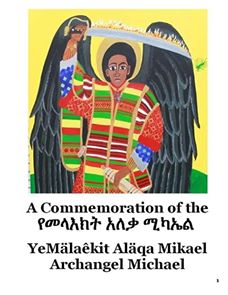
Enquan Le Leeq Melak Qidus Mika'el Beal Aderasachu!!
Happy Monthly feast of the Archangel Michael!!
|
|
Enquan Le Leeq Melak Qidus Mika'el Beal Aderasachu!!
Happy Monthly feast of the Archangel Michael!!
On this day is commemorated the glorious Archangel Michael.
On this day God, to whom be glory, sent him to Isaiah the
prophet, the son of Amos, and He had mercy upon him, and
showed compassion unto him after he had been wroth with him
for twenty-eight years. And God commanded him to go to
Hezekiah the king, and to tell him that God would heal him of his
sickness, and had add fifteen years to his days, so that he marry
and beget Manasseh.
O Mika'el O Mika'el
Leeq Melak besemayat
Endanwedik endanimot
Fetineh teradan atsenan beimnet
O Michael, O Michael
Archangel in heaven
So that we do not fall and do not die
Help us quickly, do not forget us in faith.
Salutation to Saint Micahel the Archangel.
Source: Tsega Tekle Haimanot ~ FB post ~ 22 September 2020
|
|
| |
Buhe (Ge'ez: ቡሄ)
August 19
|
|
Tsega Tekle Haimanot ~ 19 August 2020
Buhe (Ge'ez: ቡሄ)
Buhe is a holiday in Ethiopia held on August 19 (according to the Gregorian Calendar; Nahase 13 Ethiopian calendar). On this date,
the church celebrates the Transfiguration of Jesus on Mount Tabor (Debre Tabor Ge'ez: ደብረ ታቦር). People of the neighborhood tie
a bundle of sticks together to make a chibo, and set it on fire while singing songs. The main song is called "Hoya Hoye" with one
singer singing while the others follow in a rhythmic way. It involves young boys singing songs of praise outside of people's homes,
in exchange for fresh bread known as, Mulmul.
|
|
| |
| |
|
|
Nothing is hidden from God's view!...
|
|
|
|
Copyright © 2011-2020 UMOJA Connection, Inc.
All rights reserved.
|
|
|